


What to do if your child refuses to eat ?
If your child refuses to eat, you’re not alone. Many parents face this situation and feel discouraged, worried, or even powerless at mealtimes. As a dietitian, I can say that even I have struggled at times with my own daughters. I remember spending hours on baby food prep, only to be met with a firmly closed mouth.
How frustrating! It’s what drove me to combine my experience as a mother and my expertise as a dietitian to support children’s healthy eating habits.
The good news is that in most cases, this behavior is normal, and there are effective, gentle strategies that can help.
Understanding why kids push food away
Before trying to fix the problem, it’s important to understand what’s happening.
Children may refuse food because:
- they are asserting independence
- they feel pressured at the table
- they are not actually hungry
- they are sensitive to textures or flavors
- they are going through a normal developmental phase
Refusing food is often not about the food itself, it’s about control, emotions, and development.
The most common mistakes:
Even with the best intentions, some reactions can make things worse:
- forcing our child to eat
- offering a different meal immediately
- negotiating (“just one more bite”)
- turning meals into a power struggle
These approaches can increase resistance and stress around food.
Simple guidelines that make a difference:
✔️ Respect hunger and fullness
Children are naturally able to regulate their intake. Trust their appetite.
✔️ Create structure
Avoid constant grazing, offering meals and snacks at consistent times.
✔️ Keep meals pressure-free
Offer the food, let your child decide how much to eat, and accept their choice(even if they choose not to eat).
✔️ Always include one “safe” food
Serve at least one food your child usually accepts.
✔️ Repeated exposure is key
Keep in mind that children often need 8 to 10 exposures before accepting a new food.
✔️ Model healthy eating
Eat the same meal when possible because children learn by watching you.
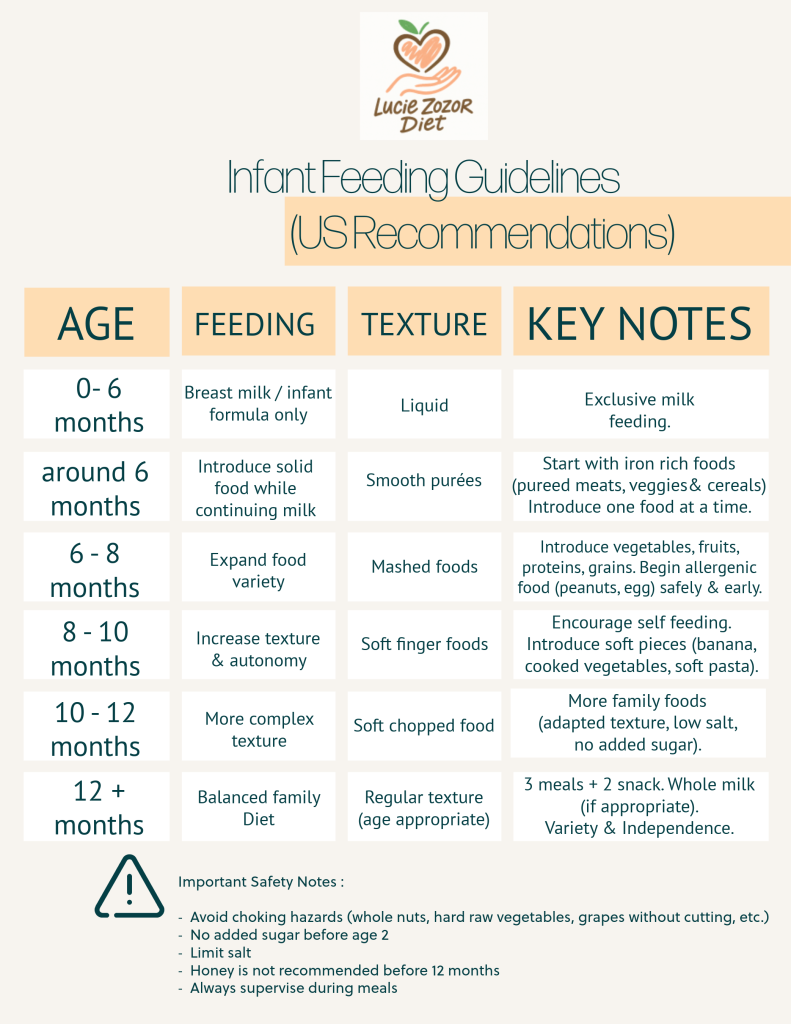
Understanding how and when to introduce different foods can make a big difference. According to CDC guidance, early exposure to a variety of tastes and textures supports healthy eating habits and may help reduce food selectivity later on.
Here is a simple overview to guide you:
Most picky eating is temporary but when should you be concerned?
You should seek professional advice if:
- your child is losing weight
- meals are extremely limited
- there is strong anxiety around food
- your child refuses entire food groups
A simple plan you can start today
If your child refuses to eat, start with these 3 simple steps:
- Set regular meal times
- Remove pressure at the table
- Offer balanced meals with one familiar food
Small, consistent changes can make a big difference over time.
Final thoughts
Helping a child who refuses to eat is not about forcing or controlling, it’s about creating a safe, structured, and calm environment around food.
With patience and consistency, most children gradually expand their eating habits and develop a healthier relationship with food.
Want a tool that actually works?
Download my free Picky Eater Survival Checklist and start making mealtimes easier today.